
IPD and BIM: How to Prepare Collaborative Project Delivery
Integrated project delivery needs clear decisions, people and information. Learn where BIM/VDC fits and how to prepare a working session that produces actionable outcomes.
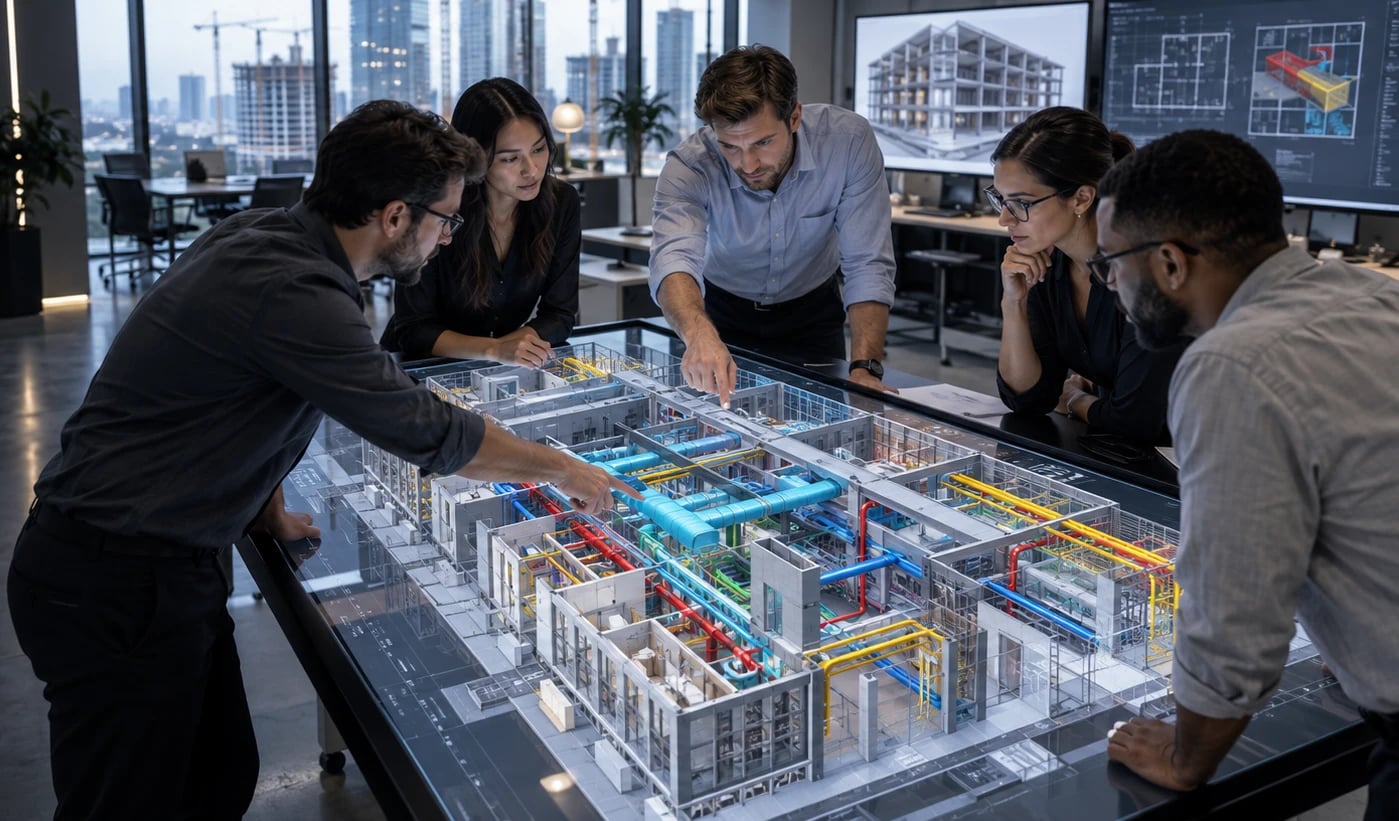
IPD means Integrated Project Delivery. It is an approach to organizing project participants and their work around collaboration. BIM and VDC can support that collaboration with shared information, model-based reviews and explicit decisions; they do not create an IPD arrangement simply by being used.
AIA's guide describes early, sustained collaboration between the owner, designer and constructor, and explains that IPD principles can be used within different contractual arrangements. When people refer to “IPD contracts,” clarify which agreement and project structure they mean. AIA: Integrated Project Delivery.
IPD, BIM and VDC have different roles
- IPD: how participants organize collaborative project delivery.
- BIM: how the team develops and manages the project information it needs.
- VDC: how models, people and work processes support project objectives and decisions.
These roles can reinforce each other. They do not remove the need to identify decision authority, scope boundaries or review responsibilities. Contractual risk, payment and legal obligations must be addressed in the actual project agreements; this article focuses on the BIM/VDC workflow.
Begin with one shared decision
Illustrative example: a project team needs to choose a plant-room arrangement. The owner has operational requirements, designers have system constraints, and construction participants need workable installation access and sequencing.
Before a meeting, identify the options, the information required to compare them, the people authorized to decide and the deadline. Use the model to make the alternatives understandable. If an input is missing, record the dependency rather than representing a preliminary choice as final.
A practical model-review agenda
- 1Confirm the decision and the criteria for comparing alternatives.
- 2Confirm model revisions, assumptions and information gaps.
- 3Review the options with the affected participants.
- 4Record the decision or the reason it remains open.
- 5Assign model updates and follow-up actions to named owners.
- 6Set the date and evidence for checking the outcome.
This proposed agenda is a working aid, not a contractual IPD requirement. Adapt it to the team's governance and the decision being made.
Information the team should agree to share
Define which models and documents are required, where they are stored, and which status makes them suitable for a particular use. Identify who prepares each submission and who checks it. A shared platform is useful only if the team can distinguish current information from superseded or provisional information.
For recurring reviews, maintain a decision register with the issue, affected location, agreed action, owner, date and reference to the updated information. Keep unresolved items visible between meetings. A closed discussion is not necessarily a completed design update.
Where 4D can help
If a decision concerns sequence, access or overlapping work zones, a schedule-linked model can support discussion. Agree which activities and scenarios are represented and which constraints remain outside the simulation. An animation alone does not establish that the proposed sequence is feasible or accepted.
Use the 4D planning guide to identify the required model and schedule inputs.
How to assess whether the workflow helps
Choose measures tied to the decision: time taken to resolve issues, actions completed by the agreed date, or work packages with outstanding coordination questions. Define how each measure is recorded before comparing periods. These are suggested management measures, not promised savings or evidence from an EZ-VDC case study.
Questions before appointing BIM/VDC support
- Which collaborative decisions should the service support?
- Who has authority to make or escalate those decisions?
- Who owns the models, updates and issue records?
- What meetings and deliverables are included?
- What must be handed over when the service ends?
EZ-VDC provides BIM/VDC support for IPD projects. Discuss your team structure and project requirements through BIM and VDC consulting, and use the proposal checklist to define the engagement.
Prepared with AI assistance to organize and draft practical explanations using the linked sources. Illustrative examples do not represent client projects or measured results.
Let's talk about your project.
Share the intended use, available information and target date. We can help define the scope and deliverables for your BIM or VDC work.

