How to Write a BIM Execution Plan: A Contractor's Guide
A BIM Execution Plan (BEP) is the single document that determines whether a VDC program produces coordinated models or expensive chaos. Without one, every team member has a different idea of what the model is for, who owns it, and what it must contain. Here is how to write a BEP that actually gets followed, not just filed.

A BIM Execution Plan (BEP) is a project-specific document that defines how BIM will be implemented across the project team. It is not a template you fill out and file away it is a living agreement that governs how the VDC program operates from preconstruction through closeout.
Why Most BEPs Fail
Many BEPs are written to satisfy a contract requirement, not to guide actual work. They are filled with boilerplate from old projects, list software versions that nobody checks, and get updated once before being forgotten.
A BEP that nobody reads is worse than no BEP at all it creates the appearance of VDC governance without the reality. Teams assume standards are being followed because there is a document, when in practice every sub is modeling to their own preferences.
A BEP that actually improves project outcomes is specific, enforceable, and referenced in every coordination meeting. Here is how to write one.
The 7 Core Sections of an Effective BEP
1. Project Information and BIM Goals
Start with the basics: project name, owner, GC, key subcontractors, BIM authoring tools, and common data environment (CDE). Then define your BIM goals not generic goals but specific and measurable ones:
- Achieve zero unresolved hard clashes prior to MEP rough-in on each floor
- Deliver a LOD 400 as-built model to the owner within 60 days of substantial completion
- Produce 4D animations for each major construction phase milestone for owner review
2. Model Standards
Define the standards all teams must follow:
- Coordinate reference system and survey point
- File naming conventions
- Object naming and shared parameter requirements
- Level/workset structure
- Model division (who models what)
3. Level of Development (LOD) Matrix
For each discipline and project phase, define the required LOD. This prevents subcontractors from over-modeling (wasting time) or under-modeling (creating coordination gaps).
4. Clash Detection Protocol
- Which discipline pairs get tested
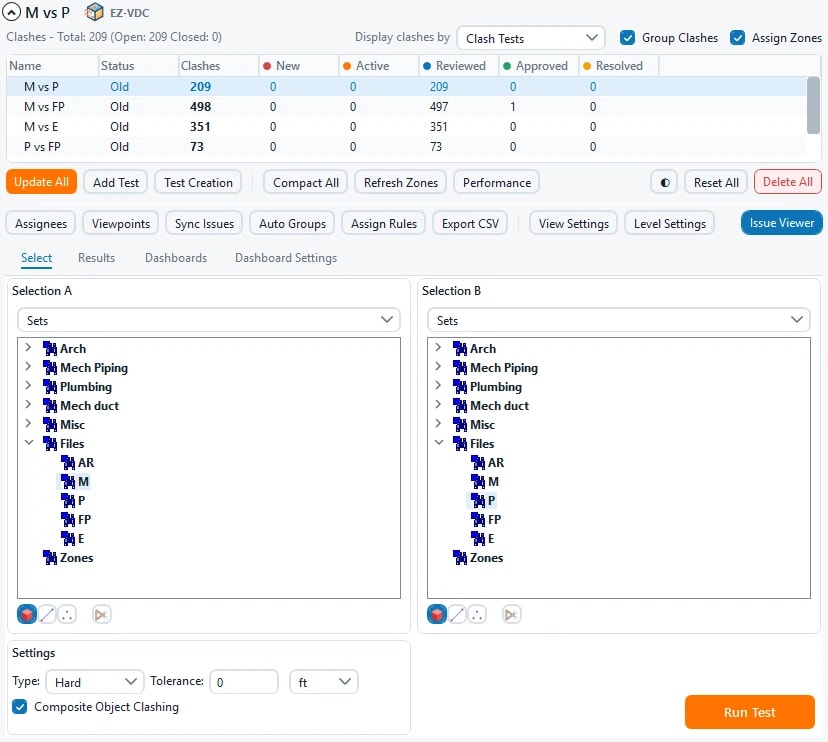
- Clash test settings (hard vs. soft, tolerance values)
- Meeting frequency and format
- Status tracking workflow and ownership matrix
- Definition of "resolved" what constitutes sign-off
5. Deliverables Schedule
List every BIM deliverable with a due date and responsible party: model milestones, clash reports, 4D animations, as-built model handover.
6. Collaboration and File Exchange
- Common data environment (BIM 360 / ACC / Procore)
- Model publishing schedule (how often subs update their models weekly is standard)
- File formats for exchange
- Access and permission structure
7. Quality Control
Who reviews models before they are published to the CDE? What are the QC criteria? How are non-conformances flagged and resolved?
"The best BEPs are built in the room, with the whole team. If the MEP sub doesn't know about model naming requirements until construction starts, they will not follow them and you cannot hold them to a document they never agreed to."
Practical Tips
Write the BEP with the project team, not for them. The BIM kickoff meeting held before any modeling begins is where the BEP is developed and agreed to. Every trade representative should understand and sign off on the standards that apply to their scope.
Keep it short. A 60-page BEP that nobody reads is less useful than a 15-page one that becomes the team's reference document. Cut every generic statement that could apply to any project if it is not specific to this job, it does not belong in the BEP.
Revisit it. At major project milestones design completion, construction start, substantial completion review the BEP and update anything that no longer reflects reality. A BEP that is 12 months out of date is not a governance document.
EZ-VDC writes and manages BIM Execution Plans as part of our VDC Consulting service based on templates developed on healthcare, education, and civic projects. Every BEP we write is specific to the project, the team, and the construction phase.
Why BEPs Fail: The Research Evidence
A 2022 global review of BIM Execution Plans published in *Automation in Construction* found that while BEPs are now contractually required on most major projects, actual adoption of their standards remains inconsistent. The most cited barriers: teams treated the BEP as a contract deliverable rather than a working document, and subcontractors were presented with standards rather than included in developing them.
A 2024 study published in *Applied Sciences* (MDPI) analyzing BEP standardization across complex construction projects found that focusing on a small number of critical elements (model standards, LOD matrix, and clash detection protocol) produced the greatest improvement in project coordination outcomes. Most BEPs cover these sections, but few define them with enough specificity to be enforceable.
The research confirms what experienced VDC managers already know: a BEP written in the room, with every trade representative present, is more valuable than a 60-page template filled in by one person. Agreement matters more than completeness.
Frequently Asked Questions About BIM Execution Plans
What is the difference between a BEP and a VDC Execution Plan?
The terms are often used interchangeably, but technically a BIM Execution Plan focuses on the technical standards for model creation, exchange, and management. A VDC Execution Plan is broader; it covers the BIM standards plus the project-level process for how BIM models will drive decisions, from coordination to schedule simulation to owner reviews. On large projects, you may have both: a VEP that defines the program strategy and a BEP that governs the technical standards.
Who writes the BIM Execution Plan?
The BEP is typically written by the VDC Manager or BIM Manager at the general contractor, in collaboration with the design team (architect, engineers) and major subcontractors. The design team is often responsible for a pre-contract BEP that establishes design-phase standards; the contractor then develops a post-contract BEP for construction execution. On design-build projects, a single integrated BEP covers both phases.
Does the owner need to approve the BIM Execution Plan?
On projects with a BIM mandate (public projects, healthcare, pharmaceutical, large commercial), the owner typically establishes BIM requirements in the contract documents and has approval rights over the BEP. On projects where the contractor initiates VDC, the BEP is typically an internal governance document with owner visibility but not formal approval. In either case, the BEP should be shared with the owner and facility management team; they will be the ultimate users of the as-built model.
How often should a BIM Execution Plan be updated?
The BEP should be reviewed and updated at each major project milestone: design development complete, construction documents issued, construction start, structural completion, MEP rough-in start, and substantial completion. It is not a document you write once; it is a living agreement. If the coordination workflow changes, if a subcontractor replaces a tool, or if the owner adds a new BIM requirement, the BEP should reflect that change within two weeks.

Stanford MS · Published Autodesk Marketplace Developer
Stanford-trained civil engineer with over a decade leading VDC on projects from $30M to $450M across healthcare, hospitality, and infrastructure.
Let's talk about your project.
Share the intended use, available information and target date. We can help define the scope and deliverables for your BIM or VDC work.